Homemade Greek Yogurt for Gut Health — The Evidence and How to Make It
Authentic Greek yogurt is made with three specific bacterial strains — Lactobacillus bulgaricus, Streptococcus thermophilus and Lactobacillus acidophilus. Each of these strains has been individually studied in the context of gut health and IBS. Making Greek yogurt at home using a live culture ensures you are delivering these strains in their living, active form — something most commercial yogurts cannot guarantee by the time they reach you.
The Three Strains and What the Research Shows
Lactobacillus bulgaricus and Streptococcus thermophilus are the original Greek yogurt starter strains, and they have been studied together in a clinically relevant IBS trial. A randomised controlled trial published in the World Journal of Gastroenterology examined IBS-D patients given fermented milk containing L. bulgaricus, S. thermophilus and L. acidophilus over 4 weeks. Intestinal permeability — a key marker of gut barrier dysfunction in IBS — decreased significantly in the treatment group (P = 0.004) versus placebo, and clinical symptom scores improved. Intestinal permeability ("leaky gut") is associated with visceral hypersensitivity and symptom severity in IBS-D; its reduction is clinically meaningful.
In laboratory models, L. bulgaricus 2038 and S. thermophilus 1131 have been shown to prevent the breakdown of tight junction proteins in the intestinal epithelium triggered by pro-inflammatory cytokines — the precise mechanism by which these strains protect gut barrier integrity. This provides a biological explanation for the clinical findings.
Lactobacillus acidophilus is the most extensively studied individual strain in IBS. A 2019 randomised, double-blind, placebo-controlled trial (the Madempudi et al. study) across 12 gastroenterology clinics found that L. acidophilus DDS-1 supplementation significantly reduced abdominal pain severity compared to placebo (52.3% of the probiotic group were significant responders vs placebo, P < 0.001). IBS Symptom Severity Scale scores also improved significantly. This is one of the more methodologically robust probiotic trials in the IBS literature.
Why Make Greek Yogurt at Home?
Commercial yogurts vary enormously in their live bacteria content. Heat treatment, extended shelf life, pasteurisation after fermentation, and the addition of stabilisers and sweeteners can significantly reduce the live culture count by the time the product is consumed. Many products labelled as "live" or "bio" contain lower CFU counts than claimed or strains that have not been tested in clinical trials.
Making Greek yogurt at home using a freeze-dried live culture sachet gives you direct control over strain quality, fermentation time and live culture content. The process is straightforward, requires minimal equipment, and produces a far richer, thicker and more consistently probiotic product than most commercially available yogurts.

How to Make Homemade Greek Yogurt
The basic process: heat full-fat milk to approximately 82°C (to denature proteins and improve texture), allow to cool to 42–44°C (the temperature at which the culture strains thrive), stir in the live culture sachet, and ferment for 8–12 hours in a yogurt maker that maintains a consistent temperature. Strain through a cheesecloth or fine mesh strainer for 2–4 hours to achieve the characteristic thick Greek yogurt texture by removing whey.
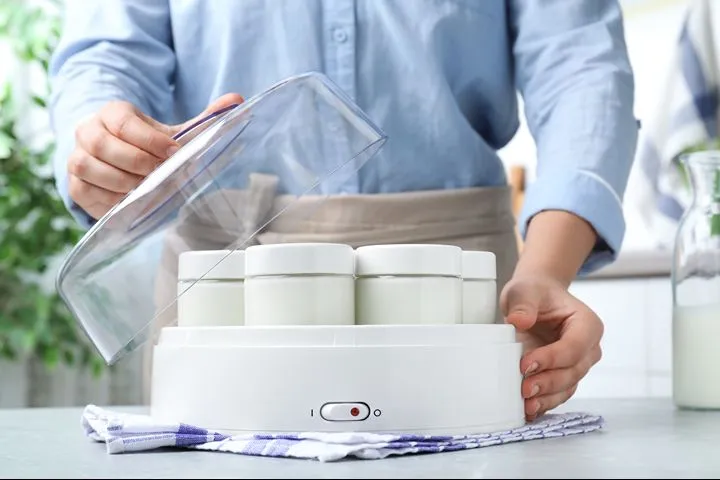
A dedicated yogurt maker is the most reliable way to maintain the consistent fermentation temperature that ensures culture viability. Countertop models that accommodate multiple jars are widely available through Amazon Ireland and are an inexpensive one-off purchase that pays for itself quickly versus buying premium probiotic yogurt.
Electric Yogurt Maker
A countertop electric yogurt maker maintains the precise temperature needed for live culture fermentation — the single most important variable in producing consistent, probiotic-rich Greek yogurt at home. Models with individual portion jars allow easy batch management.
View Yogurt Makers on Amazon →Affiliate link — IBS.ie earns a small commission on qualifying purchases at no extra cost to you.
Frequently Asked Questions
Plain Greek yogurt is low-FODMAP in servings of approximately 170g (Monash University tested). The straining process removes most of the whey and with it a significant portion of the lactose, making strained Greek yogurt lower in lactose than regular yogurt. However, individual lactose tolerance varies — those with IBS-D and significant lactose sensitivity may still react. Starting with a small portion and assessing tolerance is the practical approach.
You can use a small quantity of plain live yogurt as a starter, but the strain identity and viability are unknown. For consistent results and to ensure you are delivering the specific strains with clinical evidence (L. bulgaricus, S. thermophilus and L. acidophilus), a freeze-dried culture sachet from a specialist supplier is preferable. Culture sachets can be found from specialist online retailers.
IBS.ie
Ireland's dedicated IBS information resource. We provide evidence-based, HSE and PubMed-referenced content on irritable bowel syndrome — covering symptoms, diet, gut health and management. All content is for general information only. Always consult your GP or a qualified specialist for personal medical advice.
Related Articles


Sources & References
Madempudi, R.S., et al. (2019). Randomized clinical trial: efficacy of Lactobacillus acidophilus DDS-1 in IBS. Nutrients. View on PubMed ↗
Kajander, K., et al. (2010). A probiotic mixture alleviates symptoms in IBS patients. Alimentary Pharmacology & Therapeutics. View on PubMed ↗
Yoda, K., et al. (2014). Lactobacillus bulgaricus and S. thermophilus protect intestinal epithelial barrier function. Bioscience of Microbiota. View on PubMed ↗